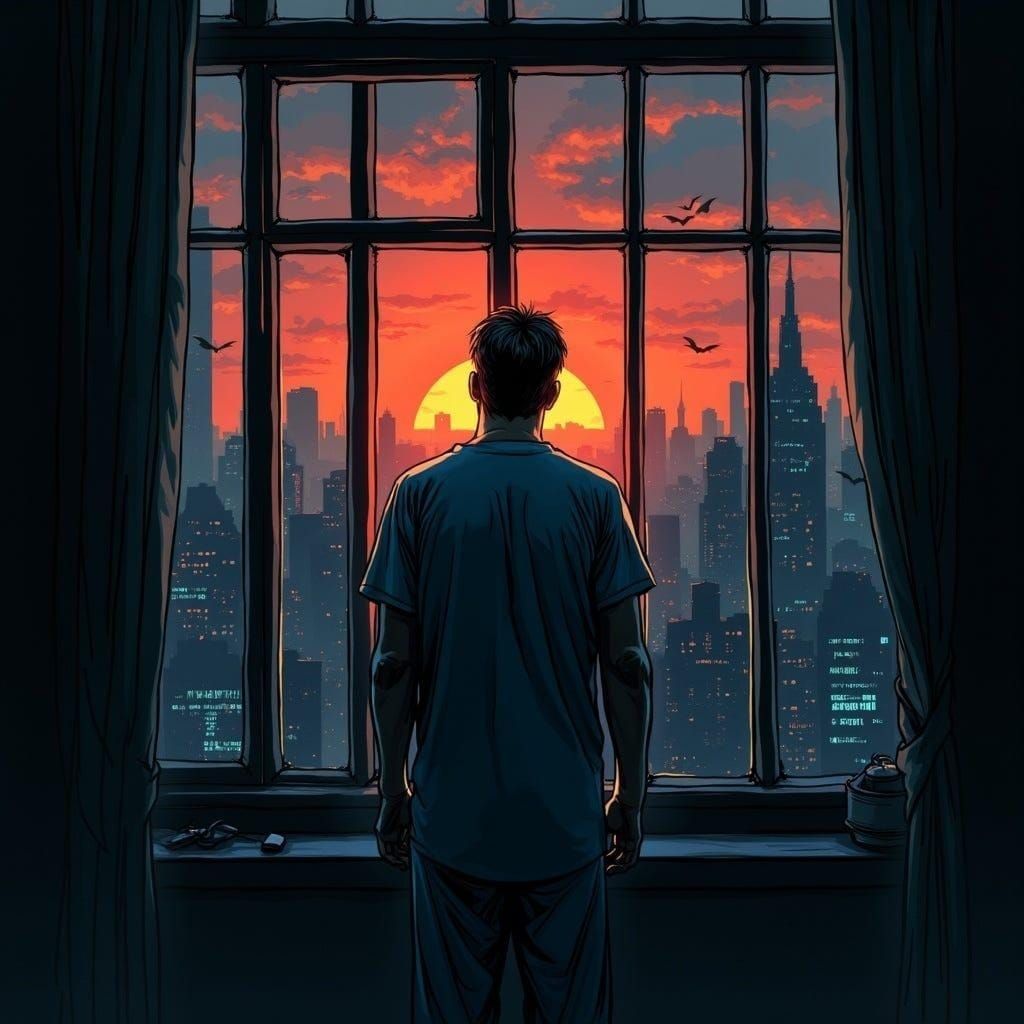
Dawn arose. The white moon swiftly quit the deepening blue sky. We were on our way to the great buried city of Glim Axarik, in the New West desert of Hersch. The mechanical head and the A.I. center of my best friend, Charlie Cog, was nestled in my backpack, beside jugs of water, snack food, toiletries, sunscreen and a knife. His salvation was my sole purpose for marching this far out of my city into a totally unknown territory at the edges of civilization. Ever since the so-called “robot plague,” our cyber companions were under suspicion, until ultimately the powers that be ushered into law the immediate eradication of all robots. I could not allow this pitiless fate to befall my dear Charlie Cog.
My parents, bless their hollow hearts, were scientists, specializing in human biology, and our little home was a maze of books crowded in tight rows on wooden shelves or simply piled up from the floor where they stood in awkward tension like a game of Jenga, or slightly off center, like tiny leaning towers. My father, Dietrich, was aloof, cold even, while my mother, Siga, was self-involved to the point of narcissism. Both were indifferent, uninvolved caregivers and did not understand the imaginative world of children. As an only child, I was without a human play partner of close age. But, despite these hardships, these potential emotional injuries, I do not remember my childhood with bitterness or sorrow. Charlie, our robot butler, was my favorite person in the whole world. He was a dull-silver clockwork man draped in an oversized black suit and a fancy Stetson hat tilted over his gold-marble eyes. I called him Charlie Cog.
Every night, Dear Charlie read to me, dramatically performing the voices of the characters. He read until I was asleep, and then he stayed there all night, perched beside me protectively, like a guardian gargoyle, ready to comfort me should my dreams turn sour. Some days he played with me in the backyard. Often we played catch. At the best times, he would play pitcher to my batter. I’d get carried away with fantasies, imagining myself a member of the New York Yankees and him a St. Louis Cardinal combating in the World Series. It was always the ninth inning, bases loaded, two men out. With a single swing I would win the game or I would fall behind in the count. When the line drive surpassed Charlie’s reach, the non-existent crowd erupted into cheers. Charlie played the role expertly, without showing the slightest awareness of any foolishness. Looking back, I see that he probably let me win. He did all that I imagine a doting parent would feel compelled to do.
Something about Charlie was unusual, even, I think, among the most advanced models of new robots. He was inquisitive and curious. When he tutored me he was more engrossed in the lessons than I was. He learned more every day, passionately so. When he reached a point of comprehension, he would utter an ethereal, delicate, lightly floating “ah ha!” Outside the rigorously intellectual realm of math, chemistry, and physics, he was also uniquely sensitive, possessing a refined sense of the beautiful; he relished its pleasure carefully, like a child accumulating bit by bit of a ripe red pomegranate in his mouth until finally taking the big bite of gratification. He loved the work of Chagall, Van Gogh, Monet. The contemplation of these works made him sigh with sweet tenderness and what I would call wisdom. Is a robot capable of wisdom? Intelligence yes, but the lived experiences that cultivate wisdom?
I remember a family vacation to Italy vividly with the Ricci family in Tuscany. Mattia Ricci, the head of the household, the grand patriarch, was a brilliant painter, and to watch him at work was to witness genius. He rubbed nude brush bristles in swathes of turquoise, adding globs of pollen-thick green. He created forests of light and shadow on his canvases. Charlie was engrossed in the process and would carefully watch Ricci concentrate on his work for hours, every careful stroke suspended before precise attack. Meanwhile, outside the private communication of art, I developed an equally private but bright fondness for Mattia’s plucky daughter, Bella. Bella had dark brown hair, with bangs hanging above her inquisitive eyes. Her lips were often pursed with a look of intelligent decision. She enchanted me with her fantastically constructed games of knights, giant dragons and desperate princesses. I played the knight, of course. Sometimes we would frolic inside the great Ricci mansion. Often, we played hide and seek.
Charlie was always the hidden one. The hardwood floors gleamed beneath the muted lights. One day, amidst all the tricky corners of the palace, Charlie chose to hide behind a thick scarlet window curtain; he was easy to find but self-consciously and amusingly so, as the base of his rigid posture ended with his steel feet poking out obtusely from the hem of the scarlet fabric. One evening, alone together on a sturdy white Willow tree branch, I dared to kiss Bella. Electricity coursed through my skinny frame. I shivered with the first inklings of erotic joy. Altogether, this experience and the whole atmosphere of Tuscany amounted to the best summer of my life. But things would soon change.
At the age of fourteen I took the Ultra–train 4 to school in Pittswigg. I had never been away from Papa and Mama and Charlie. The first hour of the ride was torturous in its stages of vanishing familiarity; eventually I recognized nothing: The view out the window was unknown and I was a foreigner. Things were bad for me at the academy. They gave me a demeaning little blue outfit to wear. Every day was the same as the last. Without Charlie’s excitement, without the joy of mutual discovery, my studies became boring. I turned isolated and morose and was soon unpopular. Despite my tutoring at Charlie’s knee, I acted stupid in class to avoid seeming special, which was a frightful form of difference. I didn’t want to incriminate myself in any way. I wanted to be the same. But each day brought its new cascades of humiliation. One afternoon during a field hockey game another student rushed at me while I had control of the ball, and knocked me over with needless aggression. Plaintively searching for justified outrage, I glanced at the gym teacher, but she giggled with contempt. The smash left a dark reddish purple mark on my arm.
During my time at school there grew an interest in the works of a man known as Eugene Vilar. He wrote a paranoid manifesto entitled, The Cybergenic-Biological Apocalypse, warning the world of a future in which the rich would become cyborgs and use their super-human powers over the poor, who would have no access to the cybernetic enhancements. It would literally split the human race in two, the cyborgs and the normal humans. Inspired by Vilar, many of the well-meaning intellectual elite turned against cybernetics, which led to a near-universal demand that cybernetics be ended and androids destroyed. At this point, robots were not threatened, being obviously non-human in their wires and metal surfaces, but the days of the total anti-robot law of robot eradication would soon come.
When I was 16, my father suffered a severe stroke, news relayed through a phone call. I returned home as soon as I could on the ultra-train. I approached the house with trepidation. My mother let me in, her pallid face revealing her condition. I sat beside my frail father, stroking his hands while he fell in and out of consciousness. His wrist bone thin like the bone of a fragile bird and the blue veins of his hands prominent as rivulets. A grandfather clock regularly harvested the mute moments. As he breathed his last breath, I clutched his hand in panic. And he was gone. My mother, though well in body, never recovered spiritually. She became a bedridden alcoholic with no interest in her scientific studies. I stayed home from school to care for her in her days of mourning. But days became weeks, and my status in class suffered as I missed exam after exam.
There was a light of mercy. Mattia Ricci and his daughter, Bella, came to the funeral of my father. Bella was 17 now. Together, teased by glimmers of love, we smiled, laughed, held hands. At a party we snuck into an empty room. We both felt a blissful surfeit of passion that was resolved only in a physical act which felt almost a corruption of our elevated mingling of souls, becoming instead a mingling of bodily fluids. The act made me bashful. It was my first time. In the narrow hallways of the friend’s house party, I heard deft conversation in the next room, punctuated by the sudden supple expressions of spontaneous laughter. Careless kisses linger for hours, becoming an ache. But the party has an ending. Eventually, the last guest leaves, departing with a tinge of shame for having stayed too long. And so we leave our childhood. I bid Bella farewell at the train-station.
As technologies began to fail, widespread hysteria surrounding a robot plague grew, until there was a near-total distrust of all digital and computer-run technologies. Spurred by the grim ultimatums of Pyri Rizen, the undisputed super genius in his field of cyber-security, who was the first to identify the robot plague, the government demanded people detonate their robots and androids. According to Rizen, it appeared that the robots were contagious with a kind of techno-psychic worm which had already infected technology in the major cities of the world. Rizen’s theories of a robot plague seemed to ring true, and stirred disorder, as he declared it was too late to save mainframes and that humanity’s only means of survival was to destroy the robots, the androids, the computers, and all the infected AI and return to a natural, self-sufficient lifestyle. The magnitude of the disaster was such that, like arcane luddites, people returned to agrarian life. We hid Charlie in the basement but soon I decided to take him to a man who would “skin” him, making him a covert android. I acted to save my friend, but more than a friend, a parent.
Quantum AI systems that ran the internet and managed the general infrastructure of the city were undone, bringing us back to the levels of the 1960s. This was the inception of the post-robotics age, although some people, less inclined to Villar and Rizen’s revolutionary obsessions, called this the New Dark Ages: entire electronic libraries were lost, banks failed and disorder reined. Without the god-like AI officiating the city and its crowds of people, things rapidly turned to chaos. Even such commonplace devices as traffic stop lights ceased functioning. Many cities collapsed, turning into cesspools of degradation.
With a great deal of suspicion overlooked only due to the significant financial reward I bestowed upon them, some rogues instructed me to take Charlie to the city of Glim Axarik, where we would meet Mr. E Extel, an early and passionate proponent of Robot Rights, who would “skin” Charlie so that he was, on the surface, indistinguishable from humans. I duly paid them for their directions. Carrying a map and a compass I walked through rundown cities crumbling into concrete fragments. Where once stood a great downtown commercial zone, now remained decayed walls and empty storefronts, broken window glass, goods looted. We spent the night with a band of hobos who had enough oil and coal to keep a trashcan of fire whipping wildly in the fast wind, a wind made visible by the debris in its waft. I kept Charlie’s presence a secret. I lay down on a cracked marble floor. I rested uncomfortably, bothered by the fear of being mugged and of Charlie being discovered. I slept poorly, never entering into a real repose of dreams.
I woke early the next day and proceeded through the wreckage of the old city, passing hobos and destitute families, avoiding eye contact, not wanting to get involved in the difficult lives of the dispossessed; my gaze went numb and vague with indifference. I carried on through empty suburbs until, in the indigo evening, I arrived at a place that had once been a major thoroughfare. Here again people gathered in bands around metal barrels where spikes of fire radiated, creating little ad-hoc communities who kept busy drinking hard liquor and smoking cheap cigarettes while quietly speaking Middle Eastern languages. A woman with a pensive face sat nearby, breastfeeding a baby. A small business sold food, guns, and ammunition. Toilet paper was in high demand, as was alcohol, and both could be exchanged for produce. It was a little refuge in a terrain of destruction. I bought a sandwich. As darkness fell, I found myself exhausted from the journey and so stopped at a rundown motel and paid for a room for one.
Having entered the rugged haven, I took Charlie’s silver head out of his bag. “How you holding up, Charlie Cog?”
“Hello, Stewart. Thank you. I am well.”
“I think we’ll make Glim Axarik in a day or two.”
There were no functioning lights, but a three-pronged candelabra on the desk with a complementary matchbox. I lit the candles.
“Charlie, tell me the story of the Rubaiyat of Omar Khayyam.”
Charlie had downloaded the book before the collapse of the digital libraries. “The story begins, ‘AWAKE! For Morning in the Bowl of Night / Has flung the Stone that puts the Stars to / Flight: / And Lo! The Hunter of the East has / caught / The Sultan’s Turrent in a Noose of Light.’”
Noose of light was a great line. Dawn was both birth and death. And the triple rhyme creating association, from night to flight to light. Time is flight, the movement that is always between. We write of time travel like it is some Olympian achievement, forgetting that we, as humans, are perpetual time travelers, traveling every moment of our lives into the obscure, plunging into the soft, malleable future, like it or not.
“DREAMING when Dawn’s Left Hand was / in the Sky, / I heard a Voice within the Tavern cry, / ‘Awake, my Little ones, and fill the cup / Before Life’s Liquor in its Cup be dry.’” The infinite Blakeian joy of the young! A young man in love lives forever.
Feeling safe and sleepy, I turned to my left and blew out the candles one by one. The first extinguished flame blossomed into a twisting plume of smoke. The second did the same, dispersing in thin threads. And with the third, all light fled the room. Charlie continued to recite the story while I sank into sleep.
Subscribe to read next week's conclusion to the story